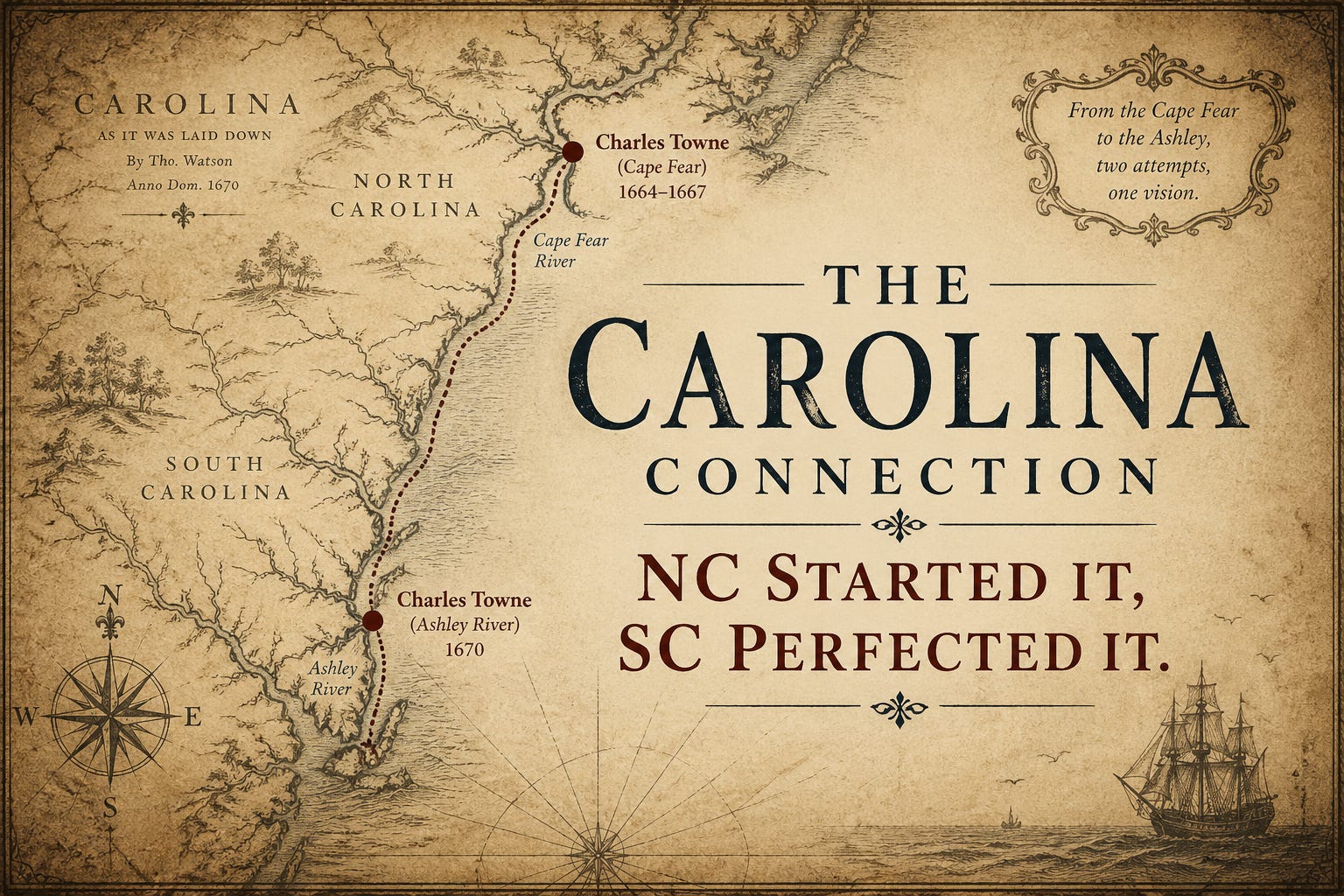
The Carolina Connection: NC Started It, SC Perfected It

There’s a version of Carolina history most people never hear. Before the pastel houses, before the wrought iron gates, before Charleston became Charleston—there was another attempt. Quieter. Rougher..
In 1664, English settlers—came up the Cape Fear River and established what they called “Charles Towne.” It was part of an early push by England’s Carolina proprietors to build a foothold on the southeastern coast—something that could function as a port, a trading hub, and eventually something much larger. It didn’t last. Obviously. BUT it is one of those little history fun facts that is just juicy enough to share.
By 1667, the settlement was abandoned. The reasons weren’t simple and are worth talking about. The river and coastline proved difficult to navigate and sustain. Governance was unstable. Supplies were inconsistent….and relationships with local Indigenous communities deteriorated into conflict….
Because it isn’t really “gone”.
I only know about it because of a mapping project I worked on while working with the North Carolina Office of State Archaeology in Raleigh. I came across it on an old map—just a name, “Charles Towne” sitting quietly where nothing seemed to be anymore. When I asked about it, the story began to unfold. Not in a way that makes headlines. Just enough to realize something had been there—and that most people had no idea. I am of the school of thought people should have more of “idea” about History.
Charles Towne, NC does not exist any more. There are no standing walls. No preserved streets. Nothing that announces, a town was here. What remains, if anything, lives below the surface: post holes, soil changes, fragments—traces of people who tried to build something and couldn’t quite hold it. That’s the part history we don’t always sit with long enough.
We tend to tell the story from the point of success—1670, the founding of Charles Towne Landing along the Ashley River, the settlement that endured and became Charleston.
But Charleston didn’t emerge out of nowhere.
It was a second attempt.
After Cape Fear failed, the English didn’t abandon the idea—they adjusted it. They moved south to a harbor that proved deeper, more defensible, and better suited to Atlantic trade. There, the same ambitions took hold and stayed. Which, depending on how you look at it, means North Carolina had it first… and South Carolina got it to stick. But even that framing—English attempts, colonial ambition—sits on top of something older.
The Cape Fear region was not empty land.
Long before English settlement, the area was home to Indigenous peoples often referred to in colonial records as the Cape Fear Indians, likely connected to eastern Siouan speaking groups and possibly related to the Waccamaw. Their presence along the river and coastal plain stretched back generations, with established systems of movement, trade, and survival tied closely to the land and waterways. Early interactions between Indigenous communities and English settlers were not one-dimensional. There were moments of exchange—land transactions recorded by colonists, shared knowledge of the environment, and attempts at coexistence. But those interactions unfolded within a colonial framework …much of what we know comes through colonial records, which means the full names, feelings and identities of these communities are not always preserved as clearly as they should be. That’s important to note.
By 1666, tensions had escalated into violence in what is known as the Clarendon County War. Within a year, the English settlement at Cape Fear was abandoned. That tension—cooperation alongside conflict, presence alongside displacement—is part of the story too. Seen clearly, the Cape Fear settlement wasn’t just a failure. It was a draft.
A test of geography.
A test of economy.
A test of whether this coastline could support what they envisioned. It was built on land that already held something older, deeper, and far more enduring.
That’s what archaeology—and sometimes a map—can show you, if you let it. Not just what survived—but what didn’t. Not just what was built—but what was abandoned. Not just the story we celebrate—but the ones we almost missed entirely. Those are important as we unravel history… as fair as we can.
Charleston didn’t begin where we say it did. It began in fragments. In false starts. In places that slipped so quietly out of memory they now exist only as faint marks on paper—and questions asked at the right moment.
History remembers what lasts. Archaeology remembers what didn’t.