Faith
Seeking God with Bare Feet on the Grass

Faith has been on my mind a great deal lately, though honestly, it has circled me for most of my life. I have written around this subject before in fragments and passing thoughts because something about it has always lingered just beneath the surface for me: the realization that so much of human belief is inherited before it is ever truly examined. We are often taught what to think long before we are taught how to think.
I was raised in private Catholic school, and like many children raised inside structured religious environments, there was an understood rhythm to belief. You followed suit. You absorbed doctrine, language, assumptions, and cultural attitudes almost osmotically. Certain ideas were presented as settled conclusions rather than open discussions. There is comfort in that structure when you are young, and I do not say that with resentment. In many ways, it gave me moral grounding, ritual, reverence, and an understanding of symbolism and service that still deeply shapes me. But I also think there was an unspoken understanding that too much questioning could become socially inconvenient. Certain curiosities felt almost like a faux pas.
That tendency to question has not always served me well within rigid systems of belief. Perhaps that is why I no longer seek dogma so much as I seek source.
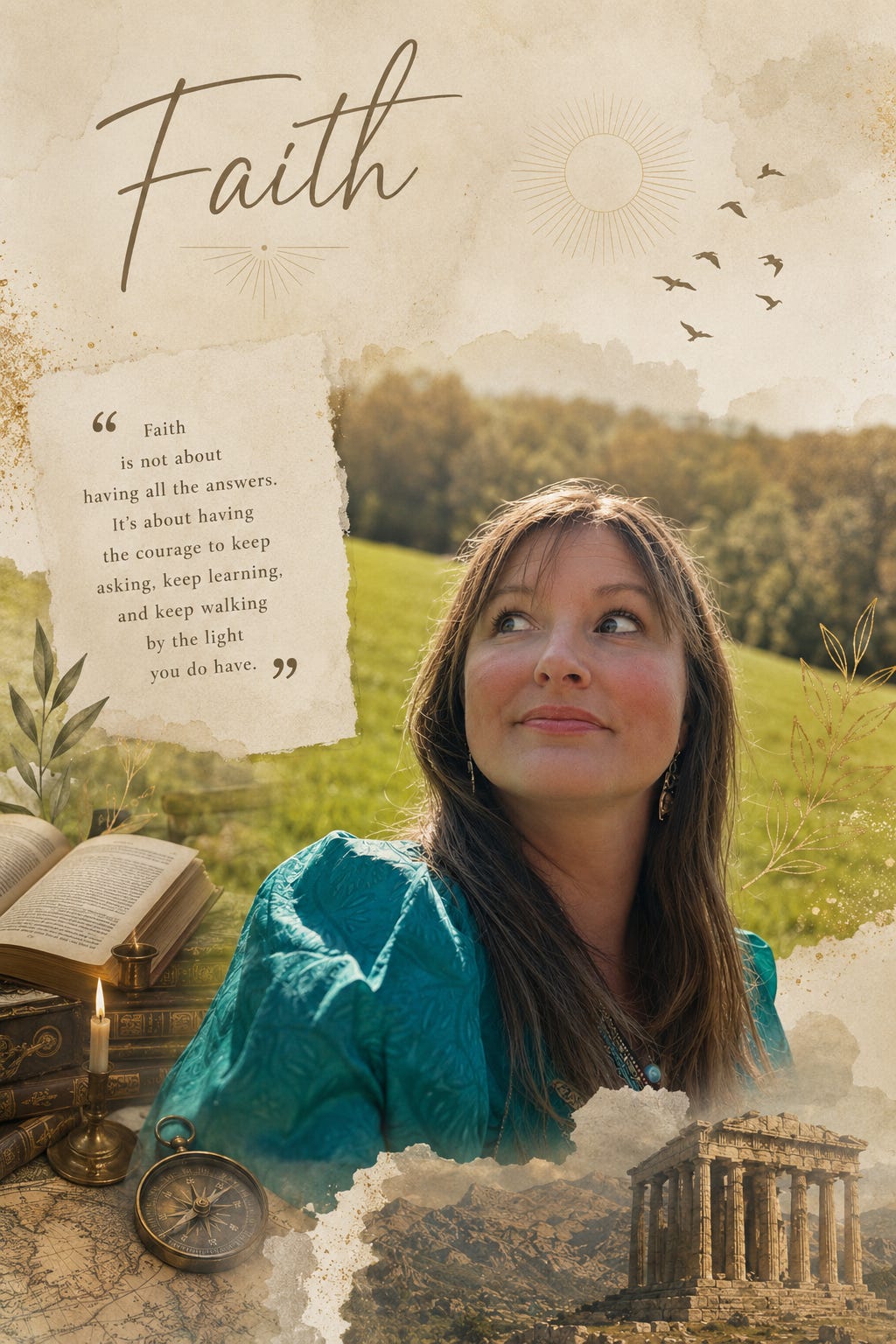
Faith for me has never existed solely inside four walls or denominational structures. It exists in the quiet moments too. In the mornings when I walk outside barefoot into the grass to ground myself before the day begins. In the instinctive way I still tilt my face upward toward the sun (or moon depending on time of day) when I pray. In the feeling that there is something profoundly connective about nature, history, ritual, and the human search for meaning. I have built an entire library around those intersections — shelves filled with religion, mythology, philosophy, anthropology, history, archaeology, spirituality, ancient civilizations, mysticism, and theology — because I cannot seem to separate them from one another. They are all humanity attempting to answer the same enormous questions from different vantage points across time.
The older I get, the more fascinated I become by the way humans construct narratives about one another’s faiths without ever sincerely engaging them firsthand. Take Islam, for instance. Many Christians in America are taught to view it as something entirely foreign, oppositional, even threatening, yet few seem aware that Muslims deeply revere Jesus — Isa — as a prophet born of the Virgin Mary, capable of miracles, and destined to return. That alone should invite far more curiosity and conversation than it does. Instead, many people settle into inherited narratives because inherited narratives are easier than investigation. We become comfortable describing belief systems we have never actually studied ourselves.
What fascinates me is not simply religion, but the broader human tendency toward intellectual tribalism. People cling tightly to certainty because certainty provides social belonging. To question openly can make communities uneasy. Families become uneasy. Institutions become uneasy. Entire systems are often built around preserving continuity, not encouraging inquiry. Somewhere along the way, questioning became framed as rebellion rather than engagement.
Yet historically, many of humanity’s greatest intellectual traditions were built upon rigorous questioning! I often think about how much I would have loved sitting in ancient Greece listening to discourse unfold in real time — philosophy, ethics, metaphysics, theology, governance — people wrestling publicly with enormous ideas without immediately reducing one another to enemies. The pursuit of wisdom itself seemed worthy of admiration. Today, we often reward confidence more than contemplation.
Perhaps that is part of why modern discourse feels so spiritually thin at times. Algorithms reward outrage, identity, and absolutism. Curiosity is slower. Nuance is slower. Snail slow. Real study is slower. It requires humility to admit that no person, institution, or denomination possesses complete understanding of the divine or even of humanity itself.
The older I become, the less interested I am in performative certainty and the more interested I am in sincere inquiry. I do not believe questioning weakens faith. If anything, I suspect honest questioning strengthens it. A faith incapable of surviving examination is not especially sturdy to begin with.
I still believe deeply in God, after 8 years of intellectual pursuit… in meaning, in morality, and in the sacredness of existence. But I also believe curiosity may itself be holy.
I am thinking perhaps faith was never intended to function as a cage that shuts inquiry down. Perhaps it was meant to function more like a lantern — something carried through darkness while we continue learning, searching, questioning, and growing in humility before the enormity of creation.
Never stop seeking friends, the journey is beautiful. 💕
Bridget I so enjoyed reading this reflection on faith and religion. I was born and brought up as a Catholic, and attended Sunday Mass with our family. Our father was very strict, an army soldier who was 9 years older than our mum. He was brought up, and mum and mostly Dad, raised all 9 of us to never question our Catholic Faith. We were not to question really anything or anyone, who had roles as parent, teacher, priest, Doctor etc. It was understood they were all knowing and knew what was best.
It was many decades later that I came to understand, through various Catholic priests,that we had a loving God, who has Grace enough for all of us to be forgiven for our sins, when we are courageous enough to confess them to a priest, at and through the sacrament of reconciliation. What a stark difference to being brought up in a church which in the 50s and 60s, seemed to only stress fear of the same God.
My practice of my faith has grown very deep in the last 15 years, partly due to my husband (since 1972) feeling called to study for 5 plus years, and then to be ordained as a Deacon in Nova Scotia 2015.
It was our shared deep faith and willingness to really pray on a major life decision, which brought us to move from east coast Canada to Ontario Canada, so we would get to spend more time with our two adult daughters and their children, just as COVID hit, in 2020. Yes, we did all the hard work and we looked at the pros and cons. But the overriding reason was to spend time with our grandkids, and developing a relationship that went beyond semi annual visits for a week.
God has been so good, and we have a beautiful church family here as well as our biological family. We have only looked back to say, thank you Jesus…we trust in you.
Peace and love 🙏❤️
Kerry D